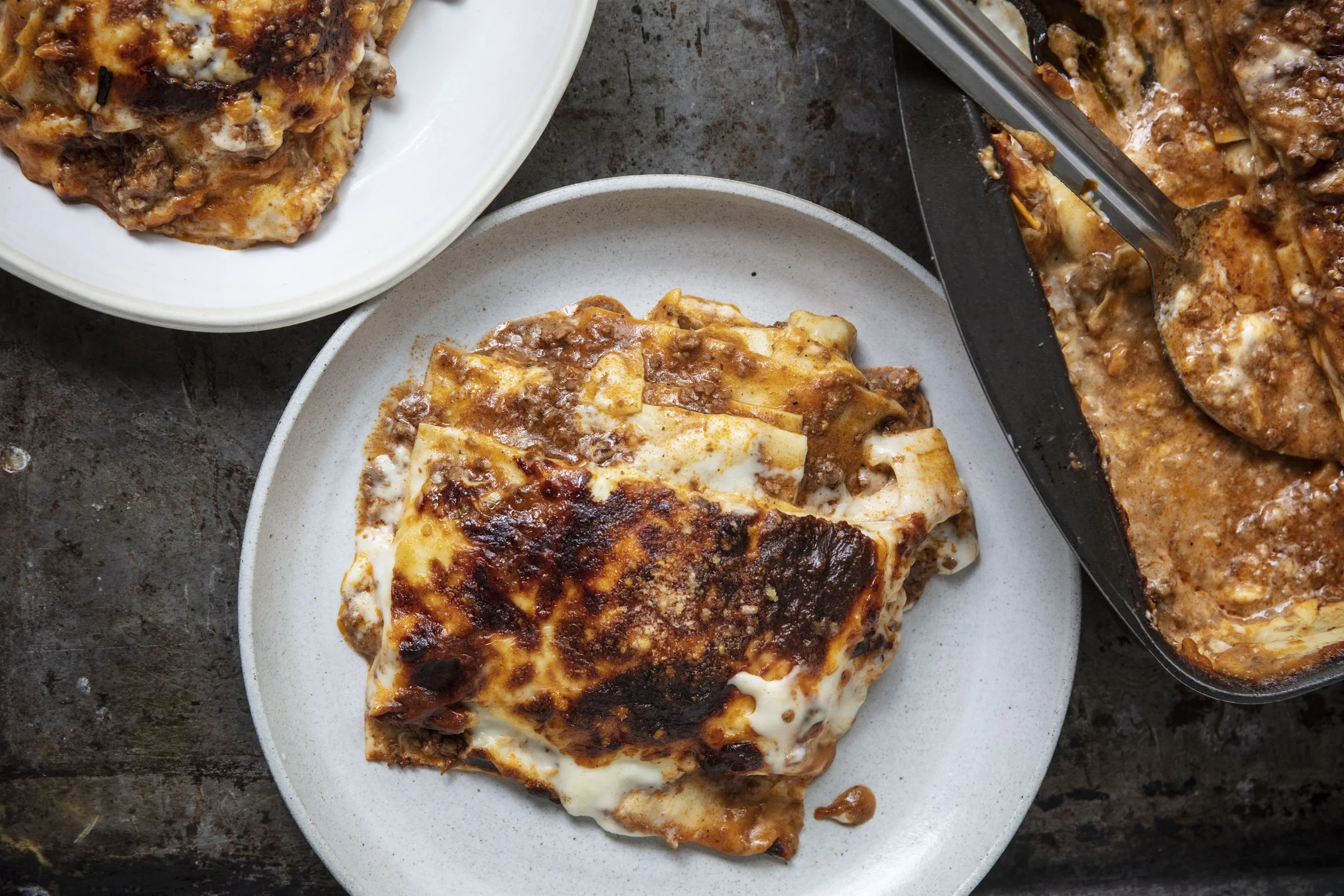
Mamma's Lasagne
Serves 8-10
This lasagne is pure comfort food for me — the kind of dish that feels like home the second it hits the table. It’s my mamma’s lasagne recipe it hasn’t changed since she first started making it for us when we were kids. It’s simple, classic, and made with love. It's layers of rich, slow-cooked bolognese, silky béchamel, pasta sheets and parmigiano, but the secret is doing each part properly. I always use the best ingredients I can afford, brown the mince well (sometimes mixing a few different meats for extra flavour), add good tomato paste and red wine, and let the sauce simmer slowly until it becomes deep and rich in flavour. Fresh herbs like parsley, thyme and sage give it that extra warmth, while a well-cooked roux is the key to a smooth, creamy béchamel. I blanch the pasta sheets so they stay tender in the oven, then build as many layers as I can fit in the dish — bolognese, pasta, béchamel, and repeat — finishing with a final blanket of sauce and a sprinkle of cheese. It’s not fancy, it’s not complicated… it’s just mamma’s lasagne, made the way it’s always been made, and it never fails to bring joy to our family.
BOLOGNESE
100 ml olive oil
1 large onion, finely chopped
2 cloves garlic, finely chopped
800 g good-quality beef mince
100 g good-quality pork mince
100 g good-quality chicken mince
1 teaspoon chopped red chilli
1 teaspoon finely chopped sage
½ cup chopped flat-leaf parsley
1 bay leaf
Pinch of ground cloves
½ nutmeg, grated
Sea salt and cracked black pepper
300 g tomato paste
200 ml red wine
PASTA DOUGH
500 g durum wheat flour, plus extra for dusting
250g whole eggs
Pinch of salt
Olive oil, for drizzling
BECHAMEL SAUCE
1 litre milk
½ small onion
1 bay leaf
1 clove
80 g unsalted butter
80 g plain flour
Sea salt and ground white pepper
A few pinches of freshly grated nutmeg
METHOD
To make the bolognese, heat the olive oil in a large saucepan over medium heat, add the onion and garlic and cook for 4–5 minutes or until softened. Add all the mince and cook, stirring constantly, until golden brown, breaking up any large lumps with the back of a wooden spoon. Mix in the chilli, herbs and spices and season with salt and pepper. Add the tomato paste and cook for 2 minutes, then pour in the wine and simmer until reduced by half. Add 4 litre water and mix well. Bring to the boil, then reduce the heat and simmer gently for 1 hour or until a rich sauce has formed.
To make the pasta dough, place the flour, eggs and salt in an electric mixer fitted with a dough hook. Mix on low speed for 6-8 minutes or until a dough has formed. Add a little water if required - the dough should be soft but not sticky. Wrap the dough in plastic film, then rest in the fridge for 2 hours.
Cut the dough into two or three pieces. Working with one piece at a time, roll the dough through the widest setting of your pasta machine, then fold it in half and roll it through again; repeat several times until the dough is silky and smooth (this is called ‘laminating’). Continue to roll the pasta through the machine, reducing the setting each time, until the dough is 1–2 mm thick.
Cut the pasta to fit the shape of the dish or tray you will be baking the lasagne in (a 30 cm x 25 cm deep baking dish, or similar), then place the sheets of pasta on a floured tray.
Bring a large saucepan of salted water to the boil. Add the pasta sheets in a few batches and stir gently to ensure they don’t stick. Cook for 4 minutes or until al dente. Remove and refresh the sheets under cold water, then drizzle with olive oil and set aside until ready to assemble.
To make the bechamel, combine the milk, onion, bay leaf and clove in a medium saucepan and warm over medium–low heat until simmering. Remove from the heat and rest for 15 minutes to allow the flavours to infuse. Melt the butter in a heavy-based saucepan over medium heat, then add the flour and stir with a wooden spoon until the mixture forms a smooth paste (roux). Cook, stirring constantly, for 2–3 minutes, taking care not to colour the roux. Strain the milk, discarding the solids, and stir it into the roux. Bring to the boil, whisking vigorously to stop any lumps forming, then reduce the heat and season to taste with salt, pepper and nutmeg. Simmer gently, stirring constantly, for 2 minutes or until thickened. It’s best to assemble the lasagne while the bechamel is still warm; in the meantime, cover closely with baking paper to avoid a skin forming.
Preheat the oven to 170°C (fan-forced).
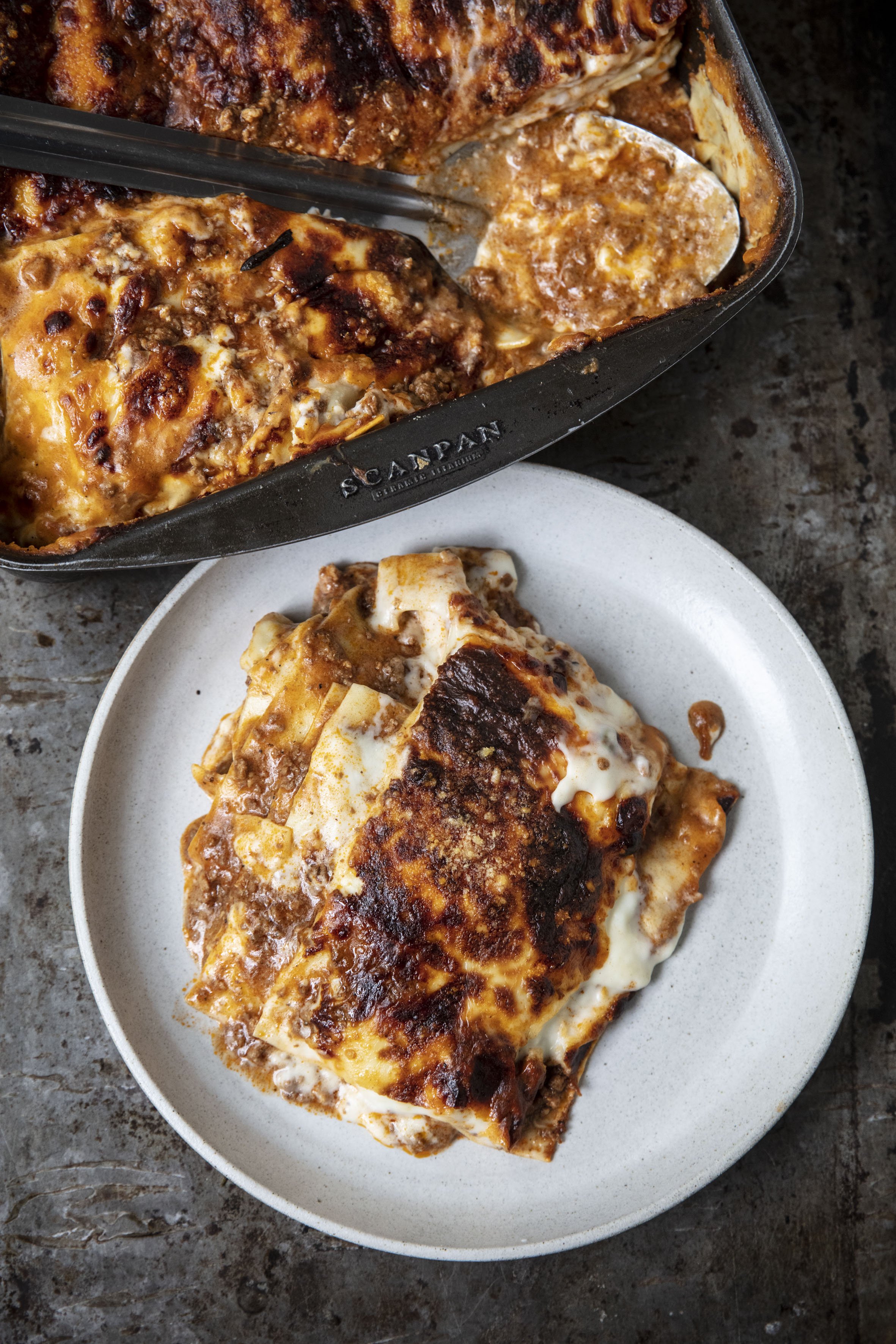
Ladle a small amount of the bolognese and the bechamel into your chosen baking dish or tray. Cover with a layer of pasta. Ladle about 1 cup (250 ml) bolognese over the pasta, top with a quarter of the bechamel and sprinkle with Parmigiano. Continue layering in this way until you reach the top of the dish, finishing with the bechamel and a final sprinkling of Parmigiano. Bake for 35 minutes or until golden and bubbling.
Serve with another sprinkle of Parmigiano and any leftover bolognese.
Products we love for this recipe:
(As an amazon associate we may earn from qualifying purchases from these links)
Wüsthof Knife - https://link.amazon/B02VIt7pT
Chopping Board - https://link.amazon/B03VDSj7K
Cobram Oil - https://link.amazon/B03VDSj7K
Wooden Spoon - https://link.amazon/B0gNUfl7L
Le Creuset Pot - https://link.amazon/B02MhqNbw
Whisk - https://link.amazon/B02EMbRLs
Olsens Salt - https://link.amazon/B01JjFYEM
Mutti Tomato - https://link.amazon/B0g073qJq
Kitchen Aid - https://link.amazon/B0fOD2MXb
Kitchen Aid Pasta Attachment - https://link.amazon/B08RfBcrB
Madein Pot - https://link.amazon/B0aqrDLYq
Madein Saucier - https://link.amazon/B0f7A5jJT
Pyrex dish - https://link.amazon/B0a0ax3rF
Ladle - https://link.amazon/B0eRejeC7